







Proposed Research
2005
Computational Studies of Selected Biophysical Processes and Biologically Relevant Systems
Scientific investigations in different areas of biological science have long and strong experimental traditions with relatively little input from theory due to the complexity of biological processes and the lack of essential computational resources that would allow large-scale simulations. Rapid advances in experimental (X-ray and NMR) structure elucidation of macromolecules as well as appearance of powerful supercomputers reduced the gap between theory and experiment and opened up new opportunities in the molecular modeling of biological processes and theoretical studies of the complex supramolecular systems.
Specific Projects
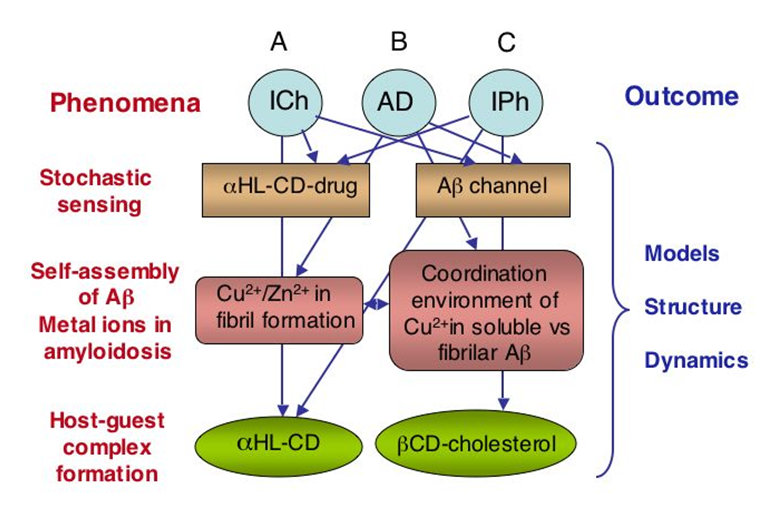
A. To investigate computationally functions and binding properties of natural and engineered channels that have applications in biotechnology (e.g. α-hemolysin ion channel) as well as molecular structure of the ion channel formed by amyloid-β peptide.
B. To study biological phenomena associated with Alzheimer’s disease by computer-aided elucidation of mechanisms through which transition metal ions participate in fibril formation (i.e. in self-association of amyloid-β peptide) and the coordination environment of metal ions in soluble and fibrillar forms of amyloid-β peptide.
C. To Study theoretically supramolecular inclusion phenomena with a focus on inclusion of cyclodextrines into the pore of α-hemolysin protein and depletion of membrane cholesterol by cyclodextrines.
B. To study biological phenomena associated with Alzheimer’s disease by computer-aided elucidation of mechanisms through which transition metal ions participate in fibril formation (i.e. in self-association of amyloid-β peptide) and the coordination environment of metal ions in soluble and fibrillar forms of amyloid-β peptide.
C. To Study theoretically supramolecular inclusion phenomena with a focus on inclusion of cyclodextrines into the pore of α-hemolysin protein and depletion of membrane cholesterol by cyclodextrines.
2012
Multidisciplinary Approach to Ecological Risk Assessment
Analysis and characterization of polluted marine sediments are of crucial importance for multidisciplinary team of scientists involved in environmental research, members of local coastal communities, governmental institutions and ecology-concerned political leaders. Political decisions on the management of contaminated sites and development of effective preventive measures are greatly influenced by results of environmental risk assessment, their quality and reliability. Assessment of sediment quality is a complex process. Chemical characterization of contaminated sediments alone does not provide sufficient information about possible chemical transformations of identified substances, implications of their accumulation by living organisms, and transmission of toxins to other biological species (e.g. humans). Therefore more integrated and multidisciplinary approach to the problem is required.
Specific Aims
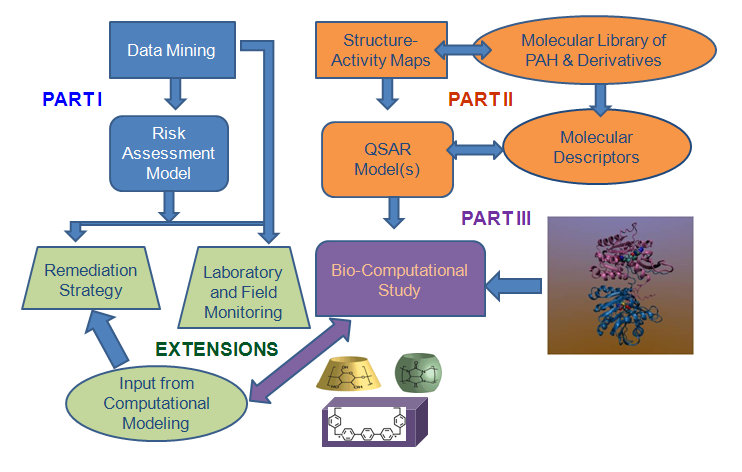
1. To generate multicomponent risk assessment model of contaminated marine sediments using results of local (i.e., site- or area-specific) ecological evaluations.
2. To build quantitative structure-activity relationships model(s) using state-of-art computational techniques, where "activity" will be represented by either toxicity, or carcinogenicity, or mutagenicity, or binding affinity between toxins and macromolecular targets.
3. To elucidate possible mechanisms and to study in detail non-specific interactions between selected representatives of polycyclic aromatic hydrocarbons and macromolecules of biological significance (e.g., hormone receptors, metabolic activators, DNA).
2. To build quantitative structure-activity relationships model(s) using state-of-art computational techniques, where "activity" will be represented by either toxicity, or carcinogenicity, or mutagenicity, or binding affinity between toxins and macromolecular targets.
3. To elucidate possible mechanisms and to study in detail non-specific interactions between selected representatives of polycyclic aromatic hydrocarbons and macromolecules of biological significance (e.g., hormone receptors, metabolic activators, DNA).
2014
Computational Modeling in Elucidating and Improving Performance of Biomaterials
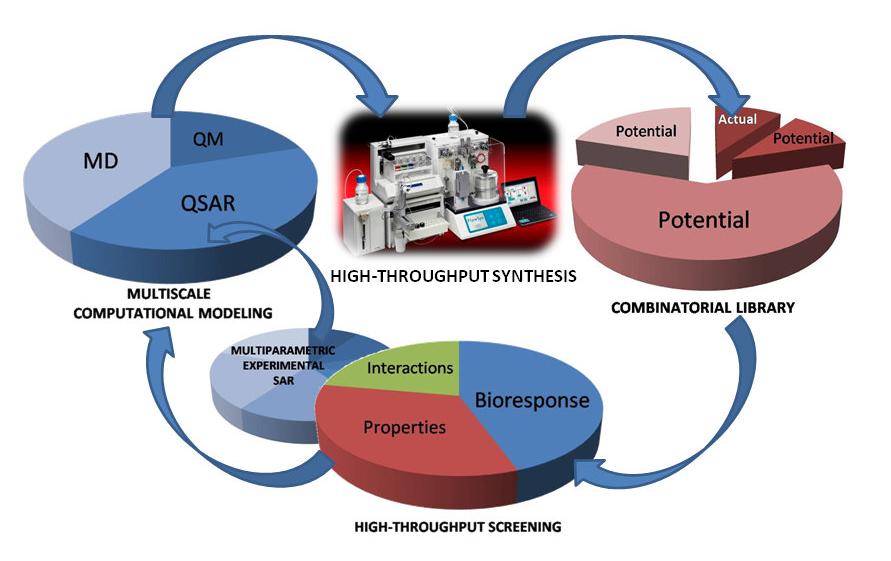
A rapidly growing trend in research of materials is associated with generating combinatorial libraries of compounds for targeted screening and applications. In biomedical and bioengineering fields focused on discovery of novel biocompatible and biodegradable polymers contemporary methods of high-throughput screening and characterization are sufficiently efficient although it remains impractical to synthesize and evaluate large combinatorial libraries in their entirety. Computer-aided approach to design of biomaterials allows creation of target-specific virtual combinatorial libraries of polymers varying in size and complexity as well as development of accurate computational models to be used for in-silico screening, identification and prediction of yet unknown, but promising candidates.
Objective and Methods
Two-fold objective of this study is to accelerate the process of material discovery and make it more cost-efficient by employing contemporary computational approaches in establishing structure-activity relationships (SAR) and elucidating structural features, biologic phenomena and mechanisms of action associated with performance of selected classes of polymeric biomaterials. Methods needed to achieve these goals are MD simulations (to study structure, conformation, and molecular interactions), electronic structure calculations (to obtain specific theoretical parameters) as well as statistical and data-mining algorithms (for establishing SAR). Utilization of molecular docking as an auxiliary tool can also be considered. Complexity of molecular simulations and statistical modeling would vary depending on the task and work schedule (e.g. insights for academic research vs development of commercial products etc.)